

Martin Duffy
Download PDF
Aug 6 2025
1
viewsthenews2.com/DepositphotosSchizocartographyis often described as a symbiosis of philosophy, politics and political geography. It has developed as a methodological approach from the collaborative worksof Gilles Deleuze & Flix Guattari. Essentially it is a technique of mapping which overtly challenges dominant power structures and narratives. It overcomes the censors and draws on potential sustenance from abroad. It is a perfect methodological apparatus to adopt when looking at an isolated, violent society such as Gaza a territory where the imposition of outside and internal powers is omnipresent, and censorship of various forms operates. This article will show how a brief experiment in locatingPalestinian protest-materialin Venice sheds light on the potential construction of a cartography of resistance.
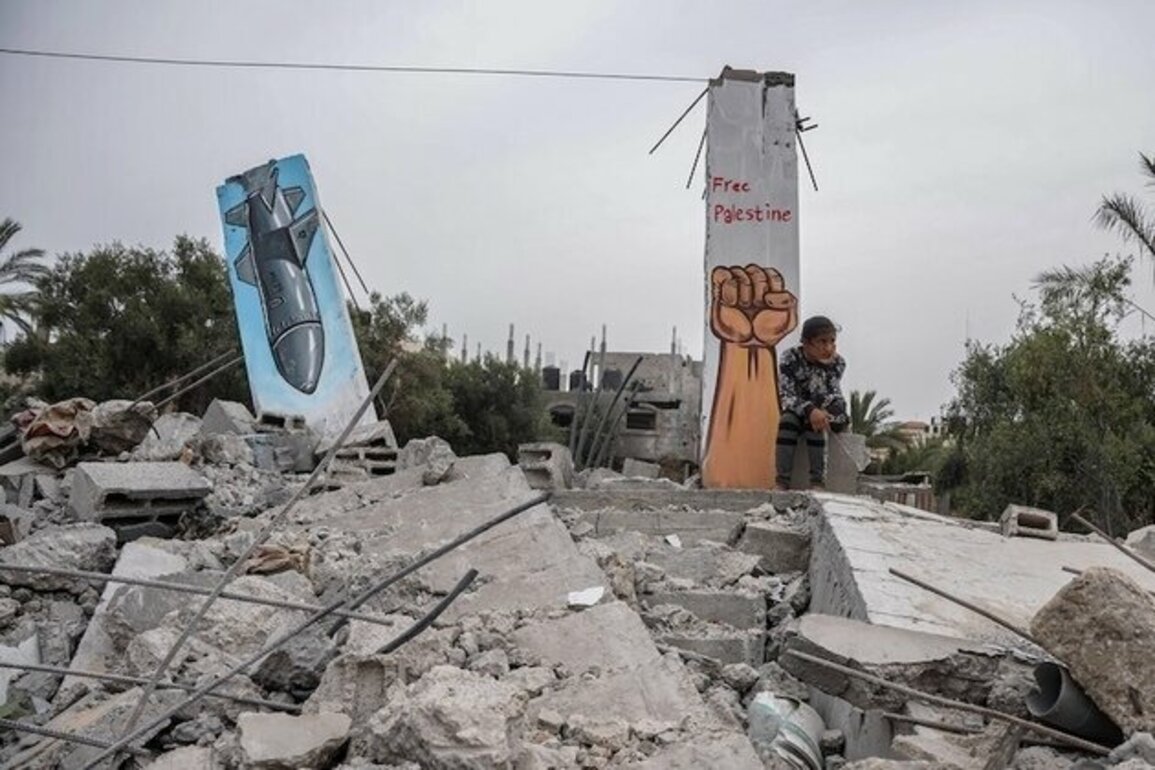
Schizocartography seeks to expose the contradictions and power dynamics within urban territories. It does so while simultaneously reclaiming the sentiments of individual subjectivity and fostering alternative modes ofcreative expression. Despite oppression and genocide,Palestinian artistsare proactively resisting their gruesome fate. They thus generate multiple vistas of civic space which are invariably controlled by forces outside the Palestinian community. Such a technique moves away from traditional psychoanalytic notions of subjectivity and instead focuses on how individuals interact persuasively with their environment. These daily synchronicities are whatGuattari and Deleuze designate as, assemblages.From one inspirational piece of artwork depicting the torture of Palestinians in Gaza, schizocartography can reveal how its message is amplified in posters, graffiti and social media, so that it becomes a crescendo of protest. Thus, Venice has become a hub of Palestinian resistance art. Schizocartography (by mapping these works) shows how a resistance campaign is deftly internationalized.
The Cartography of Palestinian Resistance Art
Palestinian resistance artpotentially encompasses creative expressions, from visual arts, music to literature, often reflecting themes of displacement and freedom. Some notable examples include: theNew Visionscollective (First Intifada); the abstract works ofexiled painterslike Jumana al-Husseini, Samia Halaby, and Kamal Boullata, and contemporary artists likeMona Hatoum and Emily Jacir. We should also mention Ghassan Kanafani who championed resistance literature, while artists like Sliman Mansour use their art to document and express thePalestinian experience under occupation.
A number of Palestinian artists, including Mohammed Alhaj, were interviewed as part of this project. Mohammeds original work, which inspired this article, came from from theDisplacement Series(2020). This article explores how Palestinian resistance-art may percolate through public spaces (such as museum posters and graffiti) and thus generate significant or evenvirtual assemblages.Thus, schizocartography incorporates elements ofpsychogeography, studying the effects of geographical environment on behaviour, by exploring the subjective experience of place. Digitally, this methodology captures the austere emotionality, inherent in much of Palestinian protest-artwork. These images are manifest in the entire portfolio ofMohammed Alhajs creative workdepicting human suffering in Gaza.
In IR and political geography alike, such schizocartographic approaches are valuable in challenging dominant narratives.By revealing contradictions and power dynamics, schizocartography aims to disrupt hegemonic chronicles, and their destructive power structures. These unreconstructed power-sources are often narrowly associated with specific locations. The schizocartographical view of the world is potentially revolutionary. This is why it is invaluable in tracking the impact of something as nebulous and ephemeral as protest-art or revolutionary street-graffiti. It encourages novel forms of creative expression and spatial practice, allowing individuals to reclaim their relationship with space and (thus) challenge the status quo. It eludes censors. This inevitably creates aresistance cartographyeven in an ostensibly formal, enduringstreetscape, like Venice.
The essence of schizocartography is that it offersvisionary toolsin mapping (as a method) to understand how spaces are constructed, experienced, and controlled.In my short experiment, I found that evidence of Palestinian protest art, such as the works by Mohammed Alhaj, were omnipresent. Perhaps the street is a more insightful purveyor of popular sentiment than state-organisations or municipal repositories? Oftentimes street-thinking expressed in cartooning is a better acid-test of the times than formal gallery-spaces.Adopting aschizocartograpical approachwe found graffito-scores and protest artistry in the most unlikely of places. This allows us to attribute a greater prominence to examples of mass culture which are not so widely evidenced in formal arts-museums. Indeed, as we will note further on, some of these original artworks have actually been banned from certain museums.
This move is significantly beyond what is depicted in the relative mundanity of traditional maps. It also implicitly calls into question the priority afforded to official Bianalles and their exhibitions. Schizocartography is thus a versatile methodological approach showing the real manifestation of protest-art in the public street. It rescues art and resilience from the clinical and sanitised glass-cases of private museums and brings the struggle genuinely unto the mundane pavement. Few people would have considered this so evident in the topographically traditional landscape of a city like Venice, but that is an important lesson for IR students to learn.
The Spatial Experience of Protest in IR
By revealing the complexities of spatial experience, schizocartography empowers individuals to reshape their relationship with environments.For this article, I examined posters near Venices main railway station. The result was a collection of ephemeral artwork-of-resistance. Violence is manifested in the threat of civilian casualties ininsurgent violenceperpetrated by freedom-fighters, and also from state-violence.Gaza is perhaps a particularly gruesome case-study. Gazan art is invariably central to activism. My pick as a prime example of resistance-art among the topography of contemporary Venice is a flyer from an exhibition on Gaza held some year or so ago in the city. It depicts Palestinian men with naked torsos running away from Israeli torture. Their nakedness is thus a symbol of resistance to the naked oppression they experience in day-to-day Gaza. It is unclear whether any of these men have themselves been involved in actions of terrorism.
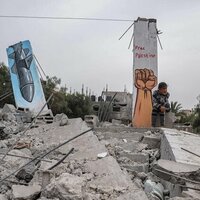
InThe Biggest Prison on Earthby Ilan Papp, we read about the decades of torture which has been inflicted on the Palestinian people. The artist whose work we have selected for this experimentMohammed Alhajchampions art-of-resistance. He opens the worlds eyes to Israels genocide in Gaza. Using only a notebook and pens, the gifted artist documents the different stages of the Gaza genocide, including scenes of ruthless displacement.The faded billboard I found near Stazione Santa Lucia is an unusually graphic example of the artists depiction of his people. During the current all-out war, virtually all artistic work has temporarily ceased.As he puts itduring an interview:
Thus begins the dramatic tale of a Palestinian artist living in Gaza who participated in the art collectiveForeigners in Their Homeland, organised by the Palestine Museum, US at Palazzo Mora in Venice.This is a moving example of how implicitly, schizocartigraohy helps us excavate the trauma of everyday life through fine arts. The exhibition, curated by Faisal Saleh, ran for six months until November 24, 2024 . It included the works of a grand total of26 Palestinian artists, shedding light on the suffering conditions of their people, who are forced to live in an apartheid situation. Mohammed Alhaj and his colleagueMaisara Barudare currently among a tiny minority of artists from Gaza exhibiting in Venice, while simultaneously trying to survive Israeli bombings.
Recently, Mohammed has been drawing only with simple ink on paper, representing his experiential situation in his artwork. It was through this that the seriesDiary of a Palestinian Displaced Personwas created for Venices Palazzo Mora. These are black-and-white drawings in which Mohammed depicts scenes of daily survival, tent camps and the flow of refugees travelling from north to south in a desperate attempt to escape the bombings in Gaza.Here is an implicit homage to schizocartography. The powerful visual messages in Alhajs creations, document life under the bombs, such as stark depictions of families huddling beneath their burning tent. These works portray a profound asymmetry in power.To quote Mohammed:
Mohammeds latest drawings (202324), and a piece that highlights the use of colours, show how the art-of-resistance may truly raise the profile of a cause. These pastel-evoking creations seek to convey Palestinians sense of disorientation caused by brutal forced displacement. The respective collections are titledThe Truth Is with You and The Land Is with Them. One drawing, a mural, describes the alienation felt by Palestinians even within the occupied territories.Mohammed explains.
This young artist was born in Tripoli, Libya, in 1982 to a Palestinian family and returned to Palestine at the age of 13. When the war broke out, he was living in Gaza City. Then, with his wife and four children, he was forced to flee to the Nuseirat refugee camp in the centre of the Strip.Subsequently, he moved to the Al-Mawasi area, between the cities of Khan Yunis and Rafah.As Mohammed states:
Mohammeds canvases, sculptures, bas-reliefs and murals were all destroyed, burned and reduced to ashes. The only traces of his artistic work are some photos he had previously published on his social media pages, in addition to the pieces preserved at the Palestine Museum, US.This tragedy opens up a debate about how we best memorialise the creativity of those whose works have been destroyed by armed conflict?As he observes:
In 2022 the Venice Biennale Arte collection. titled From Palestine with Art, was proposed by the Palestine Museum US. Due to political pressure on the Biennales organisers, the exhibition (envisaged for) Foreigners in Their Homeland was not recently included.Mohammed explains:
Schizocartography is invaluable in fleshing out the underbelly of street subcultures, such as how a societys sense of politics is expressed in its streetscape, like as political graffiti. There are diverse forms of public theatre and avenues of potential activism. AsMuhammed also argues:
The resistance art of Mohammed Alhaj is an exemplar of how schizocartography offers a method of cartography as an alternative to dominant power structures. In defiance, the work of people like Mohammed Alhaj, attempts to reveal the aesthetic and ideological contradictions that appear in urban space. It does this while simultaneously reclaiming the subjectivity of individuals, by enabling new modes of creative expression. Schizocartography thereby uniquely challenges anti-production. It robustly takes to task the homogenizing character of overriding forms which seek to silence heterogeneous voices. This is shown even in the way in which Mohammed Alhajs paintings have found themselves distilled into the popular culture of a city like Venice.
Conclusions
Schizocartography contributes to our deeper understanding of the social contours of transition or crisis. By combining the insights of philosophy, politics and political geography, this discipline helps us map the impact of phenomena such as social protest in urban environments. How societies express their emotions in public space is demonstrated not just by riots and organized or even ad hoc demonstrations, but also by a wide range of different, more subtle forms of assemblages. In the artwork of Mohammed Alhaj we see how one Gazan artist may have impact beyond the bounds of a single studio. This is all the more manifest when that studio is destroyed by bombs, and on-location news reportage is banned. Even in those worst communal moments of sacrifice, the artistic expression of that society offers both a form of memory and a space to dwell in. This is a lesson of great resonance.
Bibliography
On the works of Mohammed Alhaj,https://www.artzonepalestine.net/artists/mohammed-alhaj/artworks
Berressem, Hanjo. Felix Guattaris Schizoanalytic Ecology. Edinburgh University Press, 2020.
Ben-Zvi, Tal. Wa-Ma Nasayna (We Have Not Forgotten): Palestinian Collective Memory and the Print Work of Abed Abdi. Israel Studies, vol. 21, no. 1, 2016, pp. 183208
Buchanan, Ian. The Incomplete Project of Schizoanalysis: Collected Essays on Deleuze and Guattari. Edinburgh University Press, 2021.
Maimon, Vered, and Shiraz Grinbaum, editors. Activestills: Photography as Protest in Palestine/Israel. Pluto Press, 2016.
Salih, Ruba, and Sophie Richter-Devroe. CULTURES OF RESISTANCE IN PALESTINE AND BEYOND: ON THE POLITICS OF ART, AESTHETICS, AND AFFECT. The Arab Studies Journal, vol. 22, no. 1, 2014, pp. 827.
Stivale, Charles J. Gilles Deleuze & Flix Guattari: Schizoanalysis & Literary Discourse. SubStance, vol. 9, no. 4, 1980, pp. 4657.
Further Reading on E-International Relations
- The Gaza Crisis: Restrictions and Challenges to the Humanitarian Space in Gaza
- Gaza First: The Centrality of Gaza in Israeli-Palestinian Conflict Resolution
- Opinion Israeli Genocides in Gaza
- The Politics of Conflict Archaeology: HMP Maze as a Dark Heritage Case Study
- Gaza: A Dark History Shared by Israelis and Palestinians
- Opinion Transgressive Pedagogy in International Studies: A European Case Study
About The Author(s)
Martin Duffyhas participated in more than two hundred international election and human rights assignments since beginning his career in Africa and Asia in the 1980s. He has served with a wide range of international organizations and has frequently been decorated for field service, among them UN (United Nations) Peacekeeping Citations and the Badge of Honour of the International Red Cross Movement. He has also held several academic positions in Ireland, UK, USA and elsewhere. He is a proponent of experiential learning. He holds awards from Dublin, Oxford, Harvard, and several other institutions including the Diploma in International Relations at the University of Cambridge.